Christmas, Properly Planned: Why the Farm Shop Should Lead Your Festive Shop in 2026
Photo: tim, CC BY-SA 2.0, via Wikimedia Commons
Christmas shopping has a way of expanding to fill the space you give it. The supermarket trip gets longer, the trolley gets fuller, and somehow the fridge ends up with three tubs of something nobody actually wanted. It is not that people are careless. It is that Christmas food shopping is often done in a panic, with a vague list and a lot of background noise.
Our view is simple: the best Christmas shop starts at the farm gate, not in the supermarket aisle. That is not a romantic claim about snowy fields and handmade ribbons. It is a practical argument about quality, planning and waste. A farm shop list forces you to think about what you will actually eat, who is coming, and when you need to collect it. Those are not small things. They are the difference between a festive table that feels generous and a fridge full of half-used tubs by 27 December.
The case for a farm-shop Christmas
Supermarkets are good at selling you a Christmas. Farm shops are good at selling you the ingredients for one. There is a difference. When you buy a local turkey, a piece of properly cured ham, a wedge of cheese from a nearby dairy and a bag of sprouts that were in the ground recently, you are not just buying food. You are buying a shorter supply chain, a clearer sense of what you are eating and, in most cases, a better lunch.
The farm-shop approach also makes the planning easier. You order the centrepiece in advance. You collect it when it is ready. You buy the vegetables in sensible quantities. You do not end up with a trolley full of things that seemed like a good idea at 9pm on Christmas Eve. That is not austerity. It is good cooking.
Order the centrepiece first
If you take one thing from this guide, make it this: order your turkey and ham early. In the UK, a proper British turkey is not an infinite resource. The good ones get spoken for. Decide on your numbers first, then order a bird that fits. A smaller turkey with more sides is often better than a huge bird that leaves you eating dry meat for a week. If you are feeding a smaller group, a crown or a joint may be the smarter choice. Ask the butcher what they recommend and be honest about how many people will actually eat it.
Ham is the quiet hero of the Christmas fridge. A good gammon joint, cooked slowly and glazed, gives you Christmas Eve sandwiches, a cold cut for the table and a base for soup or hash later in the week. Order it at the same time as the turkey and you will not be chasing it in mid-December.
Cheese worth planning around
A Christmas cheese board does not need seven varieties and a mountain of crackers. Three good cheeses, well chosen, will do more than a dozen forgettable ones. Think about contrast: something hard and nutty, something soft and creamy, something blue or sharp. Local cheese is often at its best in winter, and buying it from a farm shop means you can ask what is ready now.
Buy the cheese a week or so before Christmas if it is a firm wedge, and keep it wrapped properly in the fridge. Take it out an hour before serving. Add chutney, oats biscuits, a few apples or pears and something pickled. That is a cheese board. It does not need a garnish that looks like a small forest.
Vegetables that earn their space
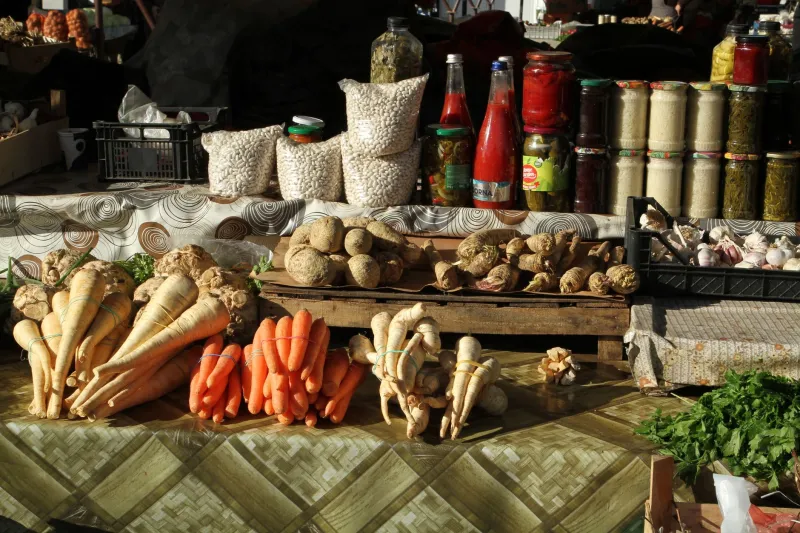
Christmas vegetables should be the best of the winter, not an afterthought. Sprouts, parsnips, red cabbage, leeks and celeriac all have a place. The trick is to cook them properly and not too many of them. Roast the parsnips until they are actually caramelised. Shred the sprouts and fry them with butter and lemon, or roast them whole. Braise red cabbage with apple and vinegar. Make a celeriac mash if you want something richer than potato.
Order a vegetable box or a set quantity rather than buying loose in a panic. Work out how many people you are feeding and how many sides you genuinely need. Two or three well-cooked vegetables are better than six that have been rushed. If you have room, prepare what you can in advance and freeze it. Braised red cabbage freezes well. So does bread sauce. So does stock made from the turkey trimmings.
Chutneys, puddings and the bits that make it feel special
This is where farm shops come into their own. A good local chutney turns cold ham and cheese into a proper meal. A proper Christmas pudding, made with suet and fruit and a bit of patience, is a different thing from a cheap one. Buy one you are excited about, not one that happens to be on offer. If you are making your own, start early and let it mature.
Do not overlook the small things: good bread, proper butter, a jar of pickled walnuts, a bag of local apples. These are the things people remember. They also make the Christmas Eve supper easier, which is worth more than a fancy centrepiece nobody has room for.
A lower-waste festive menu that still feels generous
The most wasteful Christmas habit is over-ordering. The second most wasteful is under-planning. A lower-waste menu is not about being mean. It is about buying well and using everything. Here is how to do it without making the table feel sparse.
First, plan the week, not just the day. Christmas Day is one meal. The days around it need food too. A ham gives you cold cuts and sandwiches. Turkey leftovers can become curry, pie or soup. Vegetable trimmings can become stock. Cheese ends can go into a tart or a sauce. Bread can become bread sauce, crumbs or a pudding.
Second, buy the right amount. A turkey that is too big is not generous; it is a week of obligation. A cheese board that is too large is not festive; it is a fridge-clutter problem. Buy what you will actually eat, and buy the best version of it you can afford.
Third, use your freezer properly. Make braised red cabbage in late November and freeze it. Make bread sauce and freeze it. Make stock from the ham cooking liquid and freeze it. On the day, you will be grateful for the space you have created in your own schedule.
The December 2026 countdown
A little forward planning now saves a lot of scrambling later. Here is a practical countdown for UK shoppers.
By Saturday 14 November 2026: Decide on your turkey size and ham. Talk to the butcher. Ask about collection dates and whether you need to pay a deposit. Check whether you want a whole bird, a crown or a joint.
By Saturday 21 November 2026: Order your Christmas pudding, chutney and any cheese you want to be sure of. If you are making your own pudding, this is the weekend to do it.
Weekend of 28-29 November 2026: Make and freeze braised red cabbage, bread sauce or stock. Clear a shelf in the freezer. Check your fridge space and be honest about what will fit.
Tuesday 1 December 2026: Confirm your collection slots. Order a vegetable box or decide exactly what vegetables you need. Make a list of the small things: bread, butter, cream, lemons, crackers.
Weekend of 12-13 December 2026: Collect firm cheese and any dry goods. Make chutney if you are making it. Start thinking about the Christmas Eve meal so it does not become an afterthought.
Friday 18 December 2026: Collect the ham if you are cooking it ahead. Check the turkey collection time. Make sure you have a roasting tin that fits.
Tuesday 22 December 2026: Collect fresh vegetables and the turkey if your shop allows. Keep the fridge tidy. Prep what you can: peel roots, shred sprouts, make dressings.
Christmas Eve, Thursday 24 December 2026: Collect any last fresh items. Cook the ham if you are serving it cold. Set the table. Eat something simple. Christmas Day is Friday 25 December 2026, and you will want to enjoy it.
A farm-shop Christmas is not about doing everything from scratch or spending more than you planned. It is about buying well, ordering early and cooking with a bit of thought. That is not a complicated formula. It is just a better way to shop. And it leaves you with more time for the part that actually matters: sitting down with the people you have cooked for.